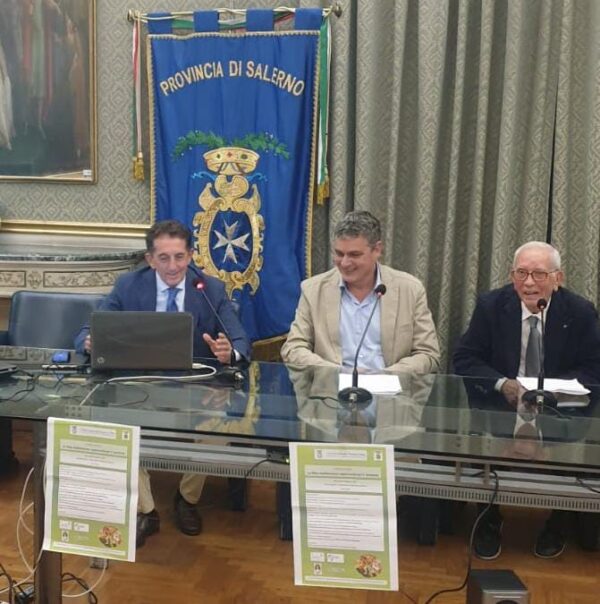
In June 2025, the Economic Society of the Province of Salerno –member of Europea International – organised a conference entitled ‘The Mediterranean Diet: opportunities for the region’.
Maurizio Murolo, the national coordinator of Europea Italia, opened the proceedings and moderated the presentations.
A brief summary of the conference is provided below.
The story dates back to the 1950s, when an American nutritionist named Ancel Keys observed that people in the Mediterranean basin lived longer and healthier lives than his fellow Americans and the inhabitants of northern European countries.
He suspected that different dietary habits lay at the root of this contrast.
He decided to leave Minnesota and move, together with his inseparable wife Margaret, to a small village in Cilento, Pioppi, in the province of Salerno, to ‘…live longer…’.
It was here that he began his research, travelling around the Mediterranean countries and studying their dietary habits.
And when he visited Crete and observed that the islanders had olive oil for breakfast before going to work in the fields, he realised that this food was not only healthy but also the cornerstone of a simple and unique diet.
In Pioppi, he built his own house with an adjoining vegetable garden, where he grew all manner of produce: seasonal vegetables and fruit.
The fact is that Keys passed away at the age of over one hundred – and just a little ‘younger’ his wife.
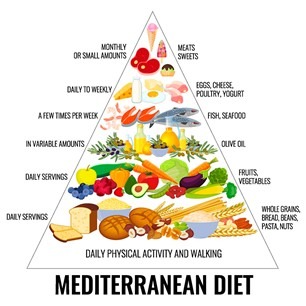
On 16 November 2010, in Nairobi, Kenya, the Intergovernmental Committee of the UNESCO Convention recognised the Mediterranean Diet as Intangible Cultural Heritage of Humanity.
Concerns are being raised from many quarters about the health effects of an unhealthy diet, particularly for children. Our children still eat far too little fruit and vegetables.
Obesity used to be associated with eating a great deal – too much.
Today, we are aware that it is linked not so much to the quantity but, above all, to the quality of one’s diet.
It is the result of unhealthy consumption patterns and lifestyles, as well as the effects of the economic crisis, which has made the class divide in diet all the more pronounced.
Poverty, alongside the consumption patterns and lifestyles promoted by the global food system, poses serious risks to our children’s future.
Despite efforts to reverse the trend, the prevalence of ‘junk food’ – food with low nutritional value and very high calorie content – has grown exponentially over the last thirty years.
The problem is such that it requires a comprehensive response: from legislative and regulatory systems, from health protection bodies, from the organisation of food production – particularly that of high-quality food – from large-scale retail chains, which can be steered in the right direction, and from schools, to reconnect food with life and culture, through the expansion of school canteens which provide a balanced, nutritious and tasty diet.
Raising awareness of the ‘Mediterranean Diet’ is a valuable, albeit small, contribution.
(Text and pics by Maurizio)